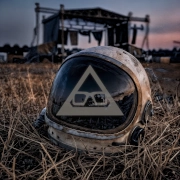
Some records make the room feel larger. Others turn a familiar drive home into a scene with its own weather, memory and private mythology. The best cinematic indie albums do both: they create scale without losing the human voice at the centre of the frame.
Cinematic does not simply mean grand strings, dramatic drums or a soundtrack-sized chorus. It can live in a close-miked breath, a distant train of reverb, a bass line that moves like headlights through rain. These albums understand pacing. They leave space around a feeling long enough for it to become yours.
What makes an indie album cinematic?
A cinematic album has an internal world. The songs do not just sit beside one another on a tracklist; they share a temperature, a colour palette and a sense of motion. Electronic detail, ambient space, post-rock lift, distorted guitars and intimate vocals can all serve that purpose, but none is essential on its own.
The trade-off is that atmosphere can sometimes come at the expense of immediacy. A record built for slow immersion may not reveal itself in a single distracted listen. That is part of its appeal. These are albums for a dark room, a long walk, a window seat, or the moment after a conversation has ended and its meaning is still changing.
12 best cinematic indie albums to live inside
This is not a fixed canon. It is a set of records that have shaped the language of emotional scale across indie, electronic, dream pop, trip-hop and post-rock. Some are enormous in sound. Others become cinematic precisely because they are restrained.
M83 – Hurry Up, We’re Dreaming
Few albums understand the emotional logic of a widescreen synth line quite like this one. Hurry Up, We’re Dreaming holds childhood wonder, restless escape and after-dark melancholy in the same glowing frame. Its biggest moments are unapologetically bright, yet the record’s real power comes from its shadows: instrumental passages and blurred vocals that feel like memories before they have fully formed.
Portishead – Dummy
Dummy is cinema with the lights mostly off. Scratched vinyl, uneasy beats, spy-film guitar and Beth Gibbons’ exposed vocal create a world that feels both elegant and deeply unsettled. It is not cinematic because it is expansive. It is cinematic because every sound seems placed under a single hard light, revealing desire, dread and distance with startling precision.
The xx – xx
The xx prove that scale is not a matter of volume. Their debut leaves enormous negative space around guitar notes, clipped beats and alternating voices. The result is nocturnal and visual – an empty street, a bedroom after midnight, two people saying less than they mean. It remains a masterclass in restraint, especially for listeners drawn to music that trusts silence.
Bonobo – Black Sands
Bonobo’s Black Sands moves with the patience of a journey rather than the urgency of a playlist. Organic percussion, warm low end and carefully layered samples create landscapes that feel physical: dusty light, water, movement, open roads. Guest vocals arrive as part of the scenery rather than interruption. It is electronic music with a human pulse and a filmic sense of place.
Sigur Rós – ( )
This is an album that treats language as texture and emotion as weather. Sigur Rós stretch their songs into vast, slow-burning forms, where bowed guitars and falsetto can feel less like individual instruments than a changing sky. The untitled structure gives the listener room to project their own story. For some, that openness will feel transcendent; for others, its patience may demand the right moment.
Mogwai – Young Team
Mogwai’s early masterpiece is built from contrast: near-whispered beginnings, towering guitar crescendos, beauty edged with noise. Young Team helped define post-rock’s cinematic vocabulary, but it has not lost its strangeness or vulnerability. The long builds are not simply about release. They make you sit inside tension until the eventual swell feels earned, not ornamental.
Beach House – Bloom
Bloom has the soft-focus glow of a dream you can almost describe. Its organs, guitars and drum machines drift together in rich colours, while Victoria Legrand’s voice remains calm at the centre. The songs are melodic enough to feel immediate, yet their emotional details keep shifting. It is ideal for anyone who wants dream pop that feels romantic without becoming weightless.
Radiohead – Kid A
Kid A is often discussed as a rupture, but it is also a remarkably coherent piece of world-building. Glacial electronics, treated vocals, jazz-leaning rhythms and uneasy melodies produce an atmosphere of technological disorientation and private grief. Its refusal to offer easy resolution is the point. This is a record that turns alienation into architecture, cold on the surface and quietly devastated underneath.
The Antlers – Hospice
Not every cinematic record is suitable for casual listening. Hospice is intimate, painful and emotionally demanding, using chamber-like arrangements, electronic texture and Peter Silberman’s fragile voice to tell a story of care, loss and damage. Its cinematic quality comes from narrative detail and emotional continuity. Approach it when you have room for a record that may leave a mark.
Tame Impala – Lonerism
Lonerism makes solitude sound bright, distorted and strangely euphoric. Kevin Parker’s dense production wraps inward-looking songs in psychedelic drums, fuzz and vivid melodic hooks. There is a playful side to the record, but also a real ache in its observations about disconnection. It feels like walking through a crowded party while hearing your own thoughts more clearly than anyone else’s voice.
Nine Inch Nails – Ghosts I-IV
This instrumental collection is a useful reminder that a song does not need lyrics to carry a scene. Ghosts I-IV moves through industrial abrasion, piano fragments, ambient drift and anxious electronics with an almost photographic attention to tone. The pieces are brief but suggestive, like a sequence of abandoned locations and half-remembered events. Its lack of a fixed narrative is exactly what makes it so visual.
The National – Trouble Will Find Me
The National make grown-up unease feel quietly monumental. On Trouble Will Find Me, careful drums, brass, piano and guitars support Matt Berninger’s low, searching voice without smoothing away the discomfort. The album’s scale is emotional rather than theatrical. It finds drama in rooms, relationships and the things people carry without saying, then lets those small details deepen over repeated listens.
How to listen for the world behind the songs
A cinematic indie album rewards attention to transitions, production choices and recurring sounds. Notice whether the drums arrive as a release or a warning. Listen for the way a vocal is placed: close enough to feel confessional, or distant enough to become part of the landscape. Pay attention to what the artist chooses not to fill.
It also helps to resist the pressure to rank every record by instant impact. A huge chorus can be thrilling, but a muted detail may stay with you longer. The strongest albums on this list each balance texture with a reason to return: a melody, a voice, an unresolved feeling, or a world that remains slightly out of reach.
For artists working between electronic production, dark pop, ambient atmosphere and post-rock texture, these records are also reminders that cinematic music does not require imitation. It asks for a point of view. Most Epic Dream lives in that same space where heartfelt melodies and shadowed production can hold both intimacy and scale.
Put one of these albums on when you have nowhere urgent to be. Let it make the ordinary route feel unfamiliar for a while, and see which detail follows you home.
Looking for somewhere else to go?
Most Epic Dream explores the space between indietronica, dark pop, ambient atmosphere and post-rock — intimate songs built inside wider cinematic worlds.
Listen to Most Epic Dream: here