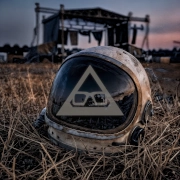
A kick drum arrives like a distant pulse. A voice sits close enough to hear the breath between words, while a synthesiser line glows somewhere beyond the edge of the room. This is the pull of dark indietronica: music that makes intimacy feel vast, and darkness feel less like an ending than a place to look closely.
It is not simply indie music with electronic drums, nor electronic music with a melancholy vocal placed on top. At its best, dark indietronica holds competing feelings in the same frame. It can be warm yet uneasy, polished yet weathered, restrained yet enormous. The songs often feel made for the moment the city has gone quiet, when old memories become unusually vivid and even ordinary light through a window seems charged with meaning.
Dark indietronica lives in the tension
The genre is less a fixed formula than a meeting point. Its roots reach into post-punk, synth-pop, trip-hop, ambient, dream pop, post-rock and dark pop. You might hear the spacious ache of The xx, the nocturnal detail of Portishead, the slow-building force of Mogwai or the synth-shadowed emotional clarity of Depeche Mode. Yet the point is not to recreate any one of those worlds. It is to use texture, rhythm and silence to give a song emotional weather.
That tension matters. A bright, clean synth chord can feel unsettling when it hangs over a low, distorted bassline. A tender lyric can become more exposed against mechanical percussion. Reverb can turn a private confession into something that appears to be echoing through an abandoned cinema.
Darkness, in this context, does not have to mean despair. It can mean uncertainty, desire, grief, memory, obsession or the strange calm after a difficult conversation. The music is often emotionally direct without spelling everything out. It leaves room for the listener’s own images to enter.
The sound is built from atmosphere, not decoration
In weaker productions, atmosphere is something added at the end: a little vinyl crackle, a cinematic pad, a few seconds of rain. In dark indietronica, atmosphere is structural. It informs the arrangement, the vocal treatment and even the amount of empty space a song is willing to hold.
A track may begin with a small repeating piano figure, a worn synth pulse or a guitar line blurred into the background. Rather than racing towards a huge chorus, it might let the elements gather slowly. Drums arrive with purpose. Bass creates weight rather than merely filling the low end. A distorted guitar may appear not as a rock gesture, but as a distant storm front.
This patience is one of the genre’s great strengths. It understands that a song does not need to explain itself in the first ten seconds. Sometimes the most affecting moment is a sound that almost disappears: the tail of a vocal, a reversed note, a beat that drops away just before resolution.
Rhythm with a human pulse
Electronic production can create precision, but dark indietronica often becomes more compelling when that precision is interrupted. A drum pattern may be steady while the vocal pushes against it. A percussion loop may carry a little grit, swing or instability. A sampled sound can feel tactile enough to suggest hands, breath and a room around the recording.
Trip-hop has left a strong imprint here. Slow or mid-tempo beats create room for tension, while sub-bass and clipped snares keep the music moving beneath a dreamlike surface. But not every song needs a heavy groove. Some use a heartbeat-like kick; others abandon drums almost entirely, allowing an ambient swell or a post-rock crescendo to take their place.
The trade-off is clear: too much polish can make a dark song feel emotionally sealed off, while too much roughness can obscure the melody. The most memorable productions preserve friction without losing the song beneath it.
Vocals that sound close, even in a large room
The voice is often the human centre of dark indietronica. It may be whispered, doubled, filtered, buried in reverb or broken into fragments, but it should still carry presence. Listeners do not need to catch every word for the performance to communicate. Tone, phrasing and the choice to hold back can say as much as a perfectly articulated lyric.
This is where emotionally honest songwriting matters. Images of night driving, empty rooms, water, light, distance and disappearing places can be powerful, but only if they serve a real feeling. Mystery is not vagueness. A lyric can leave gaps while still giving the listener something true to hold.
Why dark indietronica feels cinematic
Cinematic does not mean every song needs strings, thunderous drums or a trailer-sized climax. It means the music suggests a visual world. A listener can sense the colour of the light, the scale of the room, the distance between two people. The arrangement behaves like a camera: it can sit close on a vocal, pull back into haze, cut suddenly to silence or let a final chord widen the frame.
That visual instinct gives the genre a natural relationship with film, music videos and sync. Songs with strong atmosphere can carry a scene without demanding attention away from it. They can make a night-time road, an empty train platform or a person staring out through rain-streaked glass feel charged before anything has happened.
For independent artists, this also creates an opportunity to build a coherent creative world. Artwork, short visual pieces, photography and release-linked objects can extend the song’s emotional language. The goal is not merchandise for its own sake. It is to give a listener another doorway into the same place the music opened.
Most Epic Dream works in that space where heartfelt melodies meet electronic shadow, ambient scale and a visual world that stays slightly out of reach. The appeal is not genre purity. It is the feeling that a song can be both personal and widescreen.
Dark indietronica is not one mood
It is tempting to treat anything slow, reverbed and minor-key as dark indietronica. But a playlist of endless grey tones can become flat surprisingly quickly. The genre needs contrast. A flash of euphoria makes the melancholy hit harder. A dry vocal after a wash of effects can feel startlingly exposed. Even humour or a strange, bright sound can make the darker passages feel more believable.
There is also room for songs that move. Some lean towards dark pop, with clear hooks and a beat that stays in the body. Others drift into ambient territory, prioritising mood over structure. Some build with guitars until the electronics feel almost swallowed by noise. None of these approaches is automatically more authentic than another. It depends on what the song needs to reveal.
The useful question is not, “Does this sound dark enough?” It is, “Does every sound belong to the emotional world of this song?” A gleaming arpeggio can belong. So can a battered drum machine, a choral sample, a guitar that sounds as though it has travelled through a tunnel, or a near-silent verse. Cohesion comes from intention, not limitation.
Listening for the detail
Dark indietronica rewards attention, though it does not demand technical knowledge. Listen once for the feeling, then again for what is creating it. Notice where the low end enters, how long a chord is allowed to decay, whether a vocal is moving towards you or away from you. Notice the sounds placed at the edge of the stereo field, and the moments when the arrangement chooses not to resolve.
Often, the element that stays with you is not the loudest one. It may be a single imperfect note, a lyric that arrives half-hidden, or a sudden pocket of silence after the final beat. Those details give the music its human contour.
If a song makes the familiar feel slightly unfamiliar, let it. Put it on after midnight, on a long walk, or in the quiet space between one version of yourself and the next. The best dark indietronica does not ask you to escape your feelings. It gives them somewhere beautiful to reverberate. Hear dark indietronica from Most Epic Dream
Explore music that brings together electronic production, atmospheric textures, heartfelt melodies and darker cinematic edges across the Most Epic Dream catalogue.
Explore Most Epic Dream: https://mostepicdream.com/music/?utm_source=chatgpt.com